Replaceable intelligence, persistent accountability
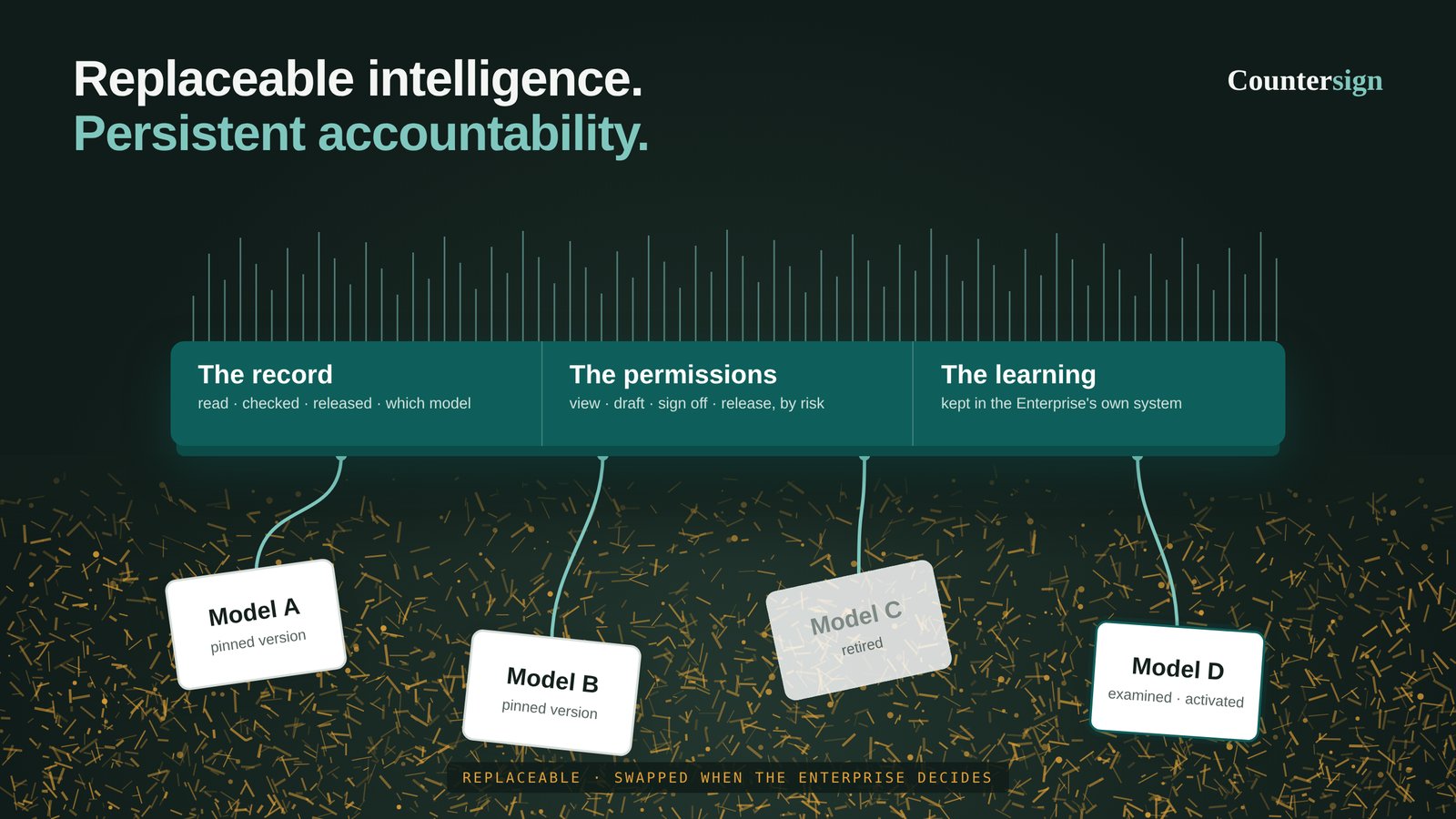
I was listening to the Moonshots podcast with Peter Diamandis this week (EP #307) and Salim Ismail said something that stopped me. Companies can't just add AI to existing workflows; the foundational principle has to be "replaceable intelligence, but with a layer of persistent accountability on top of it."
Salim's point goes further: "your security and your compliance, all those records should belong to the organisation, not to the model"; "the governance needs to be implemented by machine-readable policies"; "you have to be able to swap one model for another without losing the organisational memory and the permissions". This is what Countersign is for private markets fund administrators.
For another way to assess Countersign, point your AI agent at countersigngroup.com/agents and ask it how relevant Countersign is for your organisation.
Models are leapfrogging each other every few weeks. Whatever model is best for reading an LPA or drafting a client reply today probably won't be in six months. If the Enterprise's way of working is baked into one model, every upgrade is a migration. If it sits above the model, an upgrade is a test and a configuration change.
So what has to sit above the model? In my view, three things.
The record. What was read, what was drafted, which checks ran, who signed off, who released it, which model was used and what it cost. Written as the work happens, owned by the Enterprise, verifiable without the vendor. The model answers and remembers nothing; the record remembers everything. That is what control and quality audits test.
The permissions. Who may view, draft, sign off and release, by task and by risk, as policy the system enforces, not instructions in a prompt. A rule in a prompt is followed most of the time, and most of the time isn't a control. Built into the system rather than engineered into prompts and context, the rule survives the model change. Write it in the prompt and it has to be re-written and re-proven for every model and every version.
The learning. Every day staff correct an agent's draft, approve one, reject another. That is the most valuable data a services firm produces about how it does its work. Whether it lives in the model or in the Enterprise's own system decides who owns it. More on that next time.
Salim calls this the intelligence stack. I've been calling it one system of control: to harness, manage and drive value from AI. Same idea: the intelligence is replaceable; the accountability is persistent, and it belongs to the Enterprise.
Why it matters more for a fund administrator than most. The work is often a regulated activity, or is delivered to a client that is regulated. It is client-facing, in some markets it has depositary oversight, and it is audited by several kinds of auditor. An auditor will one day ask what an answer was based on. A client will ask why this quarter's notice reads differently from last quarter's. A regulator will ask how the firm knows its review is still working now that an agent writes the first draft. Every one of those answers needs to live above the model, not within it. The Enterprise needs to own that layer, not the vendor of the model.
That's what Countersign is designed to be: the layer the Enterprise owns, with the models plugged in underneath and swapped when the Enterprise decides.
The Moonshots podcast is worth a listen on where all this is heading.
Next time: where does the learning live, and who owns it?
Demonstration and webinar in November for anyone who wants to see Countersign.
← All news & insights