Where does the learning live?
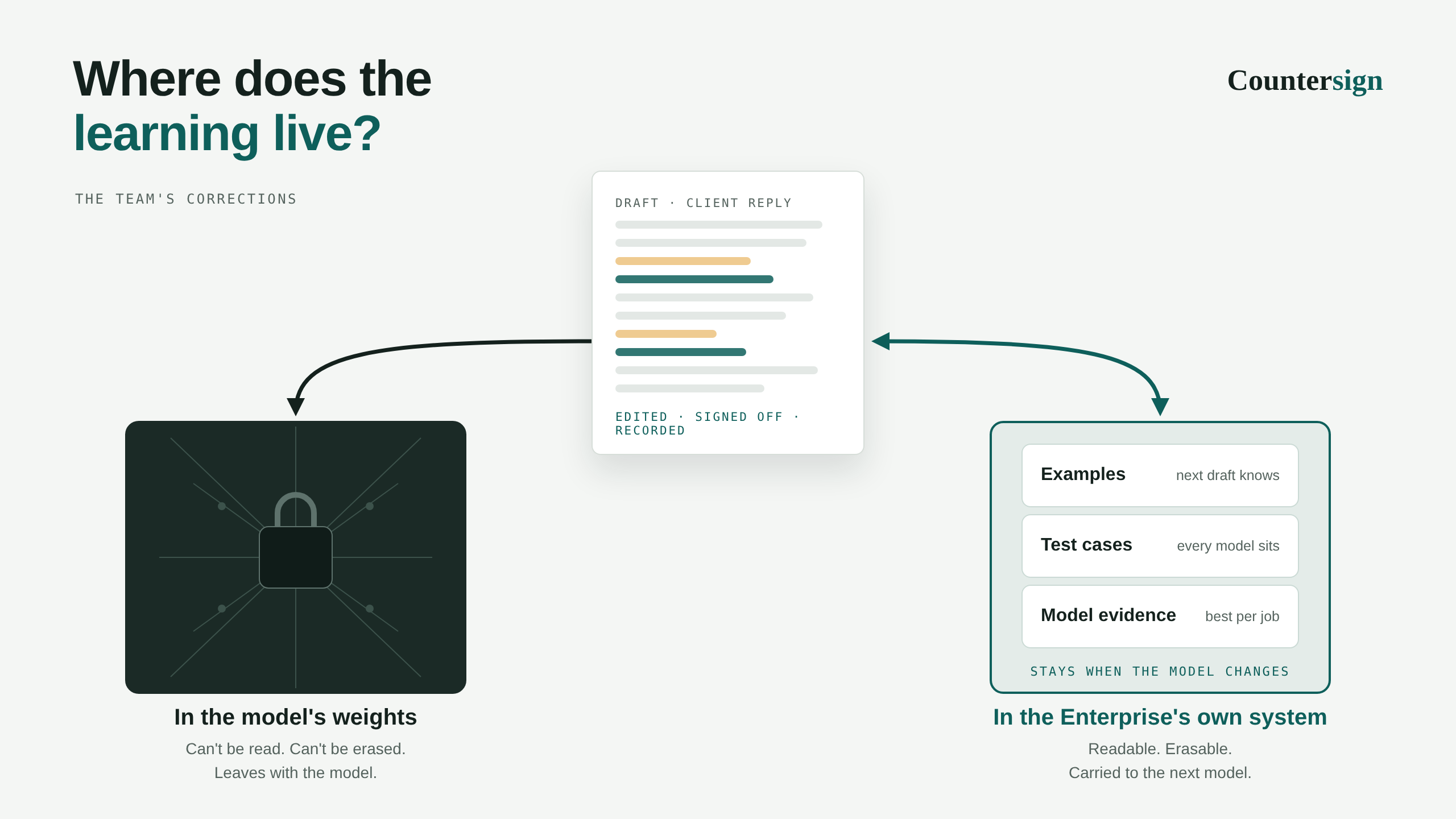
Every day in a fund administrator, someone corrects a draft, rejects one, or adds a caveat for a particular client – this is the service. Once agents do the drafting, that judgement is what teaches them. So where does it go? Agents will learn from it. The question for a regulated service is how the Enterprise harvests that learning, controls where it goes, and realises its value, without giving it away.
Harvest. In a fund administrator the loop already exists, but today most of that judgement disappears into email threads and people’s memories. Agents change that only if every correction, approval and rejection is captured against the item it belongs to: what was drafted, what changed, who changed it, and why. Without the record there is nothing to learn from, only activity.
Control. Then the choice that matters: where does the learning go? The easy route is the model’s weights. For some industries that may well be right. For a regulated service I think we need a different approach for three reasons: i) the corrections are full of client facts, and you can’t crypto-shred a weight, so client data should never go into training, ii) the learning would be tied to one model, when the Enterprise needs to swap models as better or cheaper ones arrive, iii) an auditor can read a record; nobody can read a weight.
So the learning should live in the Enterprise’s own system, as three things it keeps whichever model it uses next: examples the agents work from, so the next draft for that client already carries the caveat; test cases every future model must pass on the Enterprise’s own work before it touches a client; and evidence of which model does which job best, measured on the fund administrator’s own evaluations rather than a vendor’s benchmark. Where a model is tuned to a firm’s house style, that should happen inside the Enterprise’s estate on generalised, synthetic versions of the work, with client facts reaching the model at run time from the record, never from the weights.
Realise. Learning only counts if it shows. Fewer corrections per item. Faster turnaround on the same work. Each model chosen for each job on evidence. All read from the record rather than estimated, and all carried forward through every model change, because none of it lives in the model. That is how year two gets better than year one, in numbers the firm owns.
Another aspect is pace. At volume, quality holds only if the checking keeps up with the making. Everything is quickening. Managers are using AI to write the requests that arrive in the administrator’s inbox, turnaround expectations are shortening, and quarter-end volumes don’t shrink. Agents can make faster than any team. The constraint is the checking. If every item queues for the same review, the firm runs at the speed of its slowest reviewer and the gain is lost, or worse, the quality and integrity of the review quietly erode.
Checking keeps pace with making only when the checks are built in: every item risk-rated so the right person sees the right work, the evidence beside every draft, the mechanical checks done before a person looks, and a named person releasing what leaves the firm. Agentic operations can enable a fund administrator to meet the market’s pace; Countersign gives the Enterprise the control to keep it, and the flexibility to keep changing models.
That is what Countersign is designed to do for private markets fund administrators: harvest the team’s judgement, keep the learning in the firm, and let checking keep pace with making.
Registration is open: Countersign webinar and demonstration, Tuesday 24 November, 2pm UK, 30 minutes. Register at countersigngroup.com.
← All news & insights