Your agents, or theirs?
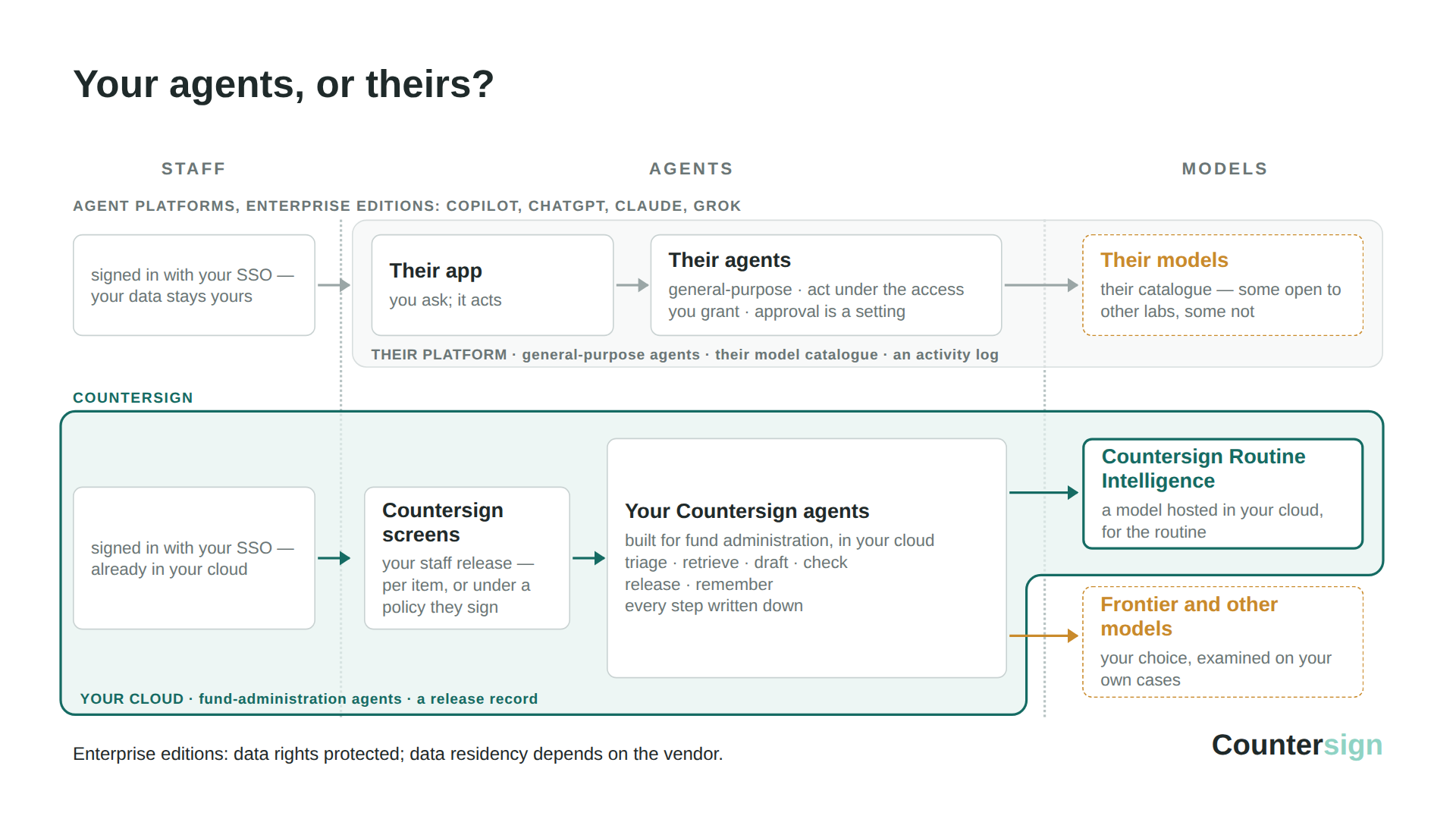
Two months, five launches. Grok Bot, OpenAI's dots, Meta's Muse, Google's Gemini agent, Microsoft's Agent 365. Each is an always-on Agent Platform that signs into the Enterprise's tools and gets on with the job.
So before the rush, one distinction that I think gets lost.
Agents are not models. A model answers a question and remembers nothing. An agent is the thing wrapped around it: it holds the task, reads the mail and documents, decides what to send the model, keeps the history, runs the tools, and acts. Think of it as front-end and back-end. The agent is the front-end — where the permissions, the validations, the user experience and the record sit. The model is the back-end — where the intelligence sits. Everything that matters to a business lives in the front-end. The picture above is the same shape top and bottom. The question is who owns the middle.
For personal productivity, the Agent Platforms serve well. Research, summaries, a first draft, a tidy inbox. The enterprise editions protect the Enterprise's data rights and access. Data residency depends on the vendor: Copilot, bundled with Microsoft 365, creates no data estate outside the Enterprise; the others host on the vendor's cloud under contract, and each Enterprise must satisfy itself on that.
Picking a platform can also mean picking its models. ChatGPT runs OpenAI's models; Claude runs Anthropic's. Copilot now offers both, and Grok Bot and Google's agent say they will route to other labs' models. So on some Agent Platforms the Enterprise's choice of front-end quietly decides its back-end too — and the vendor decides when that changes.
For a mission-critical service, I think it has to be the Enterprise's own. The moment an agent drafts the NAV, prepares a capital-call notice, answers an investor query, or touches a payment instruction, it is doing regulated work on clients' behalf under the Enterprise's permissions. In my view the Enterprise then needs to own the agent, host it, and control it: what it may read, what it may draft, what it may release, and what gets written down. Those are decisions a firm makes by risk — not settings a user toggles, not permissions managed through a prompt, not judgements a bot makes for itself. The Enterprise cannot delegate that to an Agent Platform it does not control.
Owning the agent is what gives the Enterprise the models. Once the agent is its own, the model becomes a supplier. Today's best frontier model for reading an LPA, a different one for drafting, a small bespoke model for the routine — pinned per task, tested on the Enterprise's own cases before it touches work, swapped when the Enterprise decides. Some Agent Platforms are going the other way, routing each task to whichever model the vendor judges best that week. Convenient, until the auditor or regulator asks why the model changed.
Which platform, then? I don't know how sticky Agent Platforms will be. Without planning for change from day one they will be very sticky; with that planning, perhaps the next platform actions the swap-out. There is always a pain of change. Here's an example showing my age: the move between spreadsheets in the 1990s didn't give better maths; Lotus 1-2-3, Quattro Pro and Excel changed hands on user preference and commercials. I preferred Quattro Pro. So what — Excel won, for reasons that had little to do with spreadsheets. Three winners in a decade, macros rewritten, new user functions. Maybe the Agent Platforms will write the conversions this time, and it comes down to updating the control frameworks and the humans adjusting their muscle memory.
And the resilience question. Can an Enterprise rely on one Agent Platform for any task on a mission-critical process? Is that the same as relying on a single GL or email application, or is plan B harder to introduce and manage? I think the same level of reliance, with a greater degree of uncertainty right now. If the platform is down, degraded, repriced or acquired, what happens to the capital call due at four o'clock? For anyone operating in the EU this is not rhetorical: DORA asks for exactly this — concentration risk, exit plans, the ability to keep delivering the service when a critical ICT provider fails. An Agent Platform the Enterprise does not control, running on hardware it cannot see, with a model it did not choose, is a hard thing to put in an exit plan. An agent that runs in the Enterprise's own estate, on models it has defined and can swap, is a clear response.
Whether you think a global Agent Platform is the way forward or your Enterprise should own and control its own agents, this should at least be a deliberate decision and not one that your Enterprise falls into. With a sense of the movie Men in Black, make the decision before the agents are already in the building doing the work.
For the own-your-own route, the Enterprise doesn't need to build it: Countersign is that application. Its agents are the Enterprise's, installed in the Enterprise's cloud, running client work alongside staff — the Enterprise's permissions, its release rules, its record. The models are whichever pass the Enterprise's eval tests — frontier, bespoke, or Countersign's own routine model (hosted in the Enterprise's estate). When a better model arrives, examine it and switch. When a platform disappears, switch to an alternative through a configuration setting — service continues.
Next time: once the agents are the Enterprise's own and staff are correcting them every day, where does the learning live — and who owns that learning?
Demonstration and webinar in November for anyone who wants to see Countersign.
← All news & insights